
[youtube=http://www.youtube.com/watch?v=6id140JFMUY&fs=1]
[youtube=http://www.youtube.com/watch?v=JP_3WnJ42kw&hl=en&fs=1]
[youtube=http://www.youtube.com/watch?v=5LWL2Ii7rxo&hl=en&fs=1]
This is what advertising is about: echoing conceptual jazz chants, meat slurry being extruded from a machine, and nervous chickens. (via BoingBoing)
[vimeo http://www.vimeo.com/1401236]
Ten Kens: Bearfight! from Earz Mag on Vimeo.
Strange, very strange. But I like it.
Lego gets political:
Dunechaser, the dude on Flickr who makes the best sets, has debated long and hard, but finally decided to get political. No signs of an Abu Ghraib set yet, but he has got his own version of the CIA's extraordinary rendition as well as a rather nice set-up of Fidel and Castro:

[youtube=http://www.youtube.com/watch?v=D8Vh9_Hi1kY&hl=en]


The Ray Ban Vagabond has an aviator profile but is made of plastic instead of metal. These ones have a laminated "rainbow" multi-colored frame combined with 'ambermatic variable density and colour lenses' (jeepers) which are good for varied conditions as they cut haze and boost contrast.
Check for the basement jacks...
[youtube=http://www.youtube.com/watch?v=ESpEdspH8Ok&hl=en]

Eleven species of African frogs—includingTrichobatracus robustus (top) and Astylosternus perreti (bottom)—sport a Wolverine-like defense mechanism, scientists have announced. When threatened, the amphibians pierce their skin with toe bones, sprouting makeshift claws with which to attack predators.
David C. Blackburn, a biologist at Harvard University, came across the frogs while conducting fieldwork in Cameroon. When he picked up one of the fist-size amphibians, it kicked its hind legs violently.
"I was surprised to come across frogs that can give you such a nasty scratch when you pick them up," Blackburn said. "When I got back to the U.S., I used preserved museum specimens to study the anatomy of these claws, because it was obviously pretty unusual."
After going through 63 species of African frogs, Blackburn found that in at least 11, the bones at the ends of the toes are connected to smaller and sharper free-floating bones. These smaller end bones are part of structures called nodules that are connected to the rest of the foot by a collagen-rich sheath. (Related: video: "See-Through Frogs Bred By Japanese Researchers" [October 1, 2007].)
By flexing a certain foot muscle, the frog causes the bone to retreat from the nodule and pierce the skin, revealing a clawlike structure. Unlike ordinary claws, such as those of a cat's, the frog bones do not possess a protective coating of a protein known as keratin, nor do they emerge from a specialized structure in the foot.
The frogs, all in the genera Astylosternus, Trichobatracus, or Scotobleps, appear to employ this mechanism only when threatened, as revealing the claws causes traumatic damage to the frogs' skin.
Blackburn's study is described in a forthcoming issue of the journal Biology Letters.
—Sara Goudarzi (from the National Geographic)
var gaJsHost = (("https:" == document.location.protocol) ? "https://ssl." : "http://www.");
document.write(unescape("%3Cscript src='" + gaJsHost + "google-analytics.com/ga.js' type='text/javascript'%3E%3C/script%3E"));
var pageTracker = _gat._getTracker("UA-3425016-1");
pageTracker._initData();
pageTracker._trackPageview();
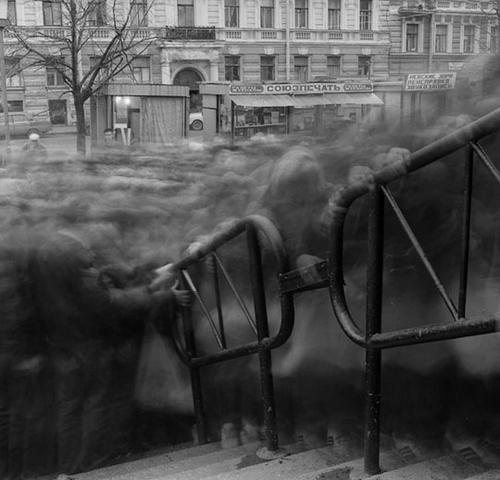
Alexey Titarenko's "City of Shadows" is a series of haunting, gorgeous long-exposure shots of street-scenes in St Petersburg, Russia. The long exposure-times turn the people in the shots into ghosts and suggestions of motion. Link, via Boingboing.
var gaJsHost = (("https:" == document.location.protocol) ? "https://ssl." : "http://www.");
document.write(unescape("%3Cscript src='" + gaJsHost + "google-analytics.com/ga.js' type='text/javascript'%3E%3C/script%3E"));
var pageTracker = _gat._getTracker("UA-3425016-1");
pageTracker._initData();
pageTracker._trackPageview();

The perfect mix of katana, Edo-stylings and contemporary counterculture references, Samurai Champloo is well worth watching.
Stuffed with swordplay, slapstick comedy and swift-moving plot, it follows Fuu (dizzy teenage girl), Jin (disgraced master swordsman) and Muguen (breakdancing psycho) as they try to find 'The Samurai who smells of sunflower', travelling across Japan and having all sorts of adventures.
The whole thing is the brainchild of Shinichiro Watanabe, the man who gave us Cowboy Bepop. As you'd expect, everything from the music to the pace of the story has been well looked after. There are terrific set-piece scenes, and fantastic attention to detail throughout.
There's a Samurai Champloo fansite here with plenty of downloads, but Veoh.com - from the embedded video above - has all the episodes for free, so you get your laptop and watch 'em in bed with a hangover.
var gaJsHost = (("https:" == document.location.protocol) ? "https://ssl." : "http://www.");
document.write(unescape("%3Cscript src='" + gaJsHost + "google-analytics.com/ga.js' type='text/javascript'%3E%3C/script%3E"));
var pageTracker = _gat._getTracker("UA-3425016-1");
pageTracker._initData();
pageTracker._trackPageview();
Wow. Just wow.
[youtube=http://www.youtube.com/watch?v=b-hzT1zBRjs&hl=en]
Mark my words, one day they'll take over.
[youtube=http://www.youtube.com/watch?v=ID_TyKdkN6A&hl=en]
[youtube=http://www.youtube.com/watch?v=YOfZPZJHnKg&hl=en]
It's so funny a little bit of wee might come out. Or so I'm told.
[youtube=http://www.youtube.com/watch?v=yyU0pe6EFBQ&hl=en]
[youtube=http://www.youtube.com/watch?v=p-OtciWgStw&hl=en]
ALLADALE (Reuters) - The howl of a wolf echoes through the glen, lumbering bears fish in the lochs and moose amble through the pine forest -- this is multi-millionaire Paul Lister's vision for his estate in the Scottish Highlands, and his grand scheme is already underway.
Last year, the British businessman spent 16,000 pounds buying a pair of moose in Sweden and flying them to Scotland in a chartered plane.
Hulda and Hercules now roam a bracken and heather-carpeted 180-hectare enclosure in the Alladale wilderness reserve, alongside newly released wild boar.
His aim is both to restore a section of the deforested and depopulated highlands to its former glory by releasing once native species into his vast Alladale wilderness reserve, and to turn a profit by charging people to visit.
"Alladale is about a restoration project, said Lister, 49, the son of the founder of UK furniture retailer MFI. "It's not about conservation -- we haven't got a lot to conserve."
Only around 1 percent of Scotland's native pinewoods remain, while many other habitats have been degraded or lost due to changes in climate and farming and forestry over the last 5,000 years or so, according to conservation charity Trees for Life.
Lister believes if bears and wolves were introduced, business at his luxury eco-resort would increase tenfold, thereby creating 100 jobs on the estate, generating 7 million pounds a year and revitalising the local economy.
"I am not just some crazed wolf man," he told Reuters.
Farmers, ramblers and neighbouring landowners remain sceptical -- and the reintroduction of wolves would have many complex consequences. But conservationists and naturalists are fascinated by the experiment, which is costing Lister around 800,000 pounds a year in capital expenditure and making a further 100,000 pounds trading loss.
Scientists from Oxford University's Wildlife Conservation Research Unit are carrying out a three-year project on the reserve, trying to monitor the impact of the boars and moose on bracken and new seedbeds for trees.
WOLF DEBATE AND LEGEND
"What he's doing is almost like a scientific experiment -- privately funded so it is no cost to the taxpayer -- to see what would happen if we re-wilded and restored parts of the old Caledonian forest in Scotland," said Richard Morley of the Wolves and Humans Foundation.
Even if Lister is not able to see all his plans through, he has ignited a public debate about the restoration of the Scottish Highlands and the reintroduction of wolves.
An academic report published last year lent credibility to Lister's plan: scientists from Norway and from Imperial College London found that wolves would help control the deer population, reducing the need for expensive culling and preventing overgrazing and the trampling of saplings.
Morley said interest in wolf reintroduction had surged since the 1960s, as people became more concerned about the environment and saw conservation efforts abroad.
"There is a feeling that we should demonstrate that we have changed and we can now live with an animal that was exterminated in the British Isles," he said.
Wolves were once common in Britain, but as a large predator and threat to livestock, were steadily exterminated from south to north, with the last wolves said to have perished in the Scottish Highlands in the mid-18th century.
The wolf is still tied up with Highlands folklore, said Iain Ross, a spokesman for the Scottish Natural Heritage (SNH), the government body in charge of conservation and restoration.
"There is a historical character called the Wolf of Badenoch who was a highland clan chieftain who was a raider, a rampager. And although it is gone from living memory, there are lots of songs and poetry which talk about the wolf," he said.
Ross said there were many people making a vocal case for the reintroduction of wolves but it was not a priority for the SNH, whose many other projects underway include a proposed reintroduction of the beaver.
"Because it is a large carnivore and predator ... the reality of it is slightly different to something like the beaver which is a mild, woodland creature that would probably run away if you came upon it," he said.
MAN-MANAGED NATURE
Everyone agrees that managing the reintroduction of wolves would be complicated and costly. The government would need to provide compensation to farmers for killed livestock, and it would have to carefully monitor the wolf population which can multiply and spread rapidly.
Even Lister says that if he does overcome all the red tape and succeeds in releasing wolves onto his estate, he will have to have them neutered.
Others suggest the whole idea of recreating primitive natural habitats is misguided. Andrew Linzey, director of the Oxford Centre for Animal Ethics and author of the book Animal Theology, says humans should just "let nature be".
"Biodiversity has led people astray into thinking that we have a moral obligation to reintroduce every species that might once upon a time have lived in a particular place," he said.
"But ecology adapts -- it moves on, indeed it is constantly changing. There never was a place of perfect biodiversity, unless you believe in a literal Garden of Eden."
(Editing by Jon Boyle and Sara Ledwith)
© Thomson Reuters 2008 All rights reserved.
[youtube=http://www.youtube.com/watch?v=VwuuWiKn5ik&hl=en]
Iconic fashion designer Yves Saint-Laurent has died at age 71. It is in part because of his influence on modern popular style that trousers (or pants, if you're an American) are now considered fashionable for women.
Two snips from the NYT obit:
Originally a maverick and a generator of controversy — in 1968, his suggestion that women wear pants as an everyday uniform was considered revolutionary — Mr. Saint Laurent developed into a more conservative designer, a believer in evolution rather than revolution. He often said that all a woman needed to be fashionable was a pair of pants, a sweater and a raincoat. “My small job as a couturier,” he once said, “is to make clothes that reflect our times. I’m convinced women want to wear pants.”
“Every man needs aesthetic phantoms in order to exist,” Mr. Saint Laurent said at the announcement of his retirement. “I have known fear and the terrors of solitude. I have known those fair-weather friends we call tranquilizers and drugs. I have known the prison of depression and the confinement of hospital. But one day, I was able to come through all of that, dazzled yet sober.”
var gaJsHost = (("https:" == document.location.protocol) ? "https://ssl." : "http://www.");
document.write(unescape("%3Cscript src='" + gaJsHost + "google-analytics.com/ga.js' type='text/javascript'%3E%3C/script%3E"));
(post pinched off BoingBoing)
var pageTracker = _gat._getTracker("UA-3425016-1");
pageTracker._initData();
pageTracker._trackPageview();
 Silly helmet covers. Get yours here.


Genius picture from Kiku.