Dude can't even answer a (fairly simple) question:
See more funny videos at Funny or Die

Dude can't even answer a (fairly simple) question:
[youtube=http://www.youtube.com/watch?v=T1K-dTMpkRo&color1=0xb1b1b1&color2=0xcfcfcf&hl=en&fs=1]
 The latest MAKE: Weekend Project video guides you in the creation of an old-school Battlestar Galactica Cylon pumpkin complete with the scanning LED eye.
Originally from BoingBoing.
More Obamatude, reuniting the original Bud cast for this.
[youtube=http://www.youtube.com/watch?v=Qq8Uc5BFogE&color1=0xb1b1b1&color2=0xcfcfcf&hl=en&fs=1]
[youtube=http://www.youtube.com/watch?v=07kO9TtHYzQ&color1=0xb1b1b1&color2=0xcfcfcf&hl=en&fs=1]
What's truly shocking is that in the first bit, she can't name any of the newspapers she reads.
Jesus did, beeyatch. This guy... wow, what a preacher. Compelling stuff.
I like his hair.
[youtube=http://www.youtube.com/watch?v=Gi7uGdCzKIA&color1=0xb1b1b1&color2=0xcfcfcf&hl=en&fs=1]

Politically incorrect adverts in a reissued book.
A fascinating commentary piece from Wired.com by Bruce Schneier:
Most counterterrorism policies fail, not because of tactical problems, but because of a fundamental misunderstanding of what motivates terrorists in the first place. If we're ever going to defeat terrorism, we need to understand what drives people to become terrorists in the first place.
Conventional wisdom holds that terrorism is inherently political, and that people become terrorists for political reasons. This is the "strategic" model of terrorism, and it's basically an economic model. It posits that people resort to terrorism when they believe -- rightly or wrongly -- that terrorism is worth it; that is, when they believe the political gains of terrorism minus the political costs are greater than if they engaged in some other, more peaceful form of protest. It's assumed, for example, that people join Hamas to achieve a Palestinian state; that people join the PKK to attain a Kurdish national homeland; and that people join al-Qaida to, among other things, get the United States out of the Persian Gulf.
If you believe this model, the way to fight terrorism is to change that equation, and that's what most experts advocate. Governments tend to minimize the political gains of terrorism through a no-concessions policy; the international community tends to recommend reducing the political grievances of terrorists via appeasement, in hopes of getting them to renounce violence. Both advocate policies to provide effective nonviolent alternatives, like free elections.
Historically, none of these solutions has worked with any regularity. Max Abrahms, a predoctoral fellow at Stanford University's Center for International Security and Cooperation, has studied dozens of terrorist groups from all over the world. He argues that the model is wrong. In a paper (.pdf) published this year in International Security that -- sadly -- doesn't have the title "Seven Habits of Highly Ineffective Terrorists," he discusses, well, seven habits of highly ineffective terrorists. These seven tendencies are seen in terrorist organizations all over the world, and they directly contradict the theory that terrorists are political maximizers:
Terrorists, he writes, (1) attack civilians, a policy that has a lousy track record of convincing those civilians to give the terrorists what they want; (2) treat terrorism as a first resort, not a last resort, failing to embrace nonviolent alternatives like elections; (3) don't compromise with their target country, even when those compromises are in their best interest politically; (4) have protean political platforms, which regularly, and sometimes radically, change; (5) often engage in anonymous attacks, which precludes the target countries making political concessions to them; (6) regularly attack other terrorist groups with the same political platform; and (7) resist disbanding, even when they consistently fail to achieve their political objectives or when their stated political objectives have been achieved.
Abrahms has an alternative model to explain all this: People turn to terrorism for social solidarity. He theorizes that people join terrorist organizations worldwide in order to be part of a community, much like the reason inner-city youths join gangs in the United States.
The evidence supports this. Individual terrorists often have no prior involvement with a group's political agenda, and often join multiple terrorist groups with incompatible platforms. Individuals who join terrorist groups are frequently not oppressed in any way, and often can't describe the political goals of their organizations. People who join terrorist groups most often have friends or relatives who are members of the group, and the great majority of terrorist are socially isolated: unmarried young men or widowed women who weren't working prior to joining. These things are true for members of terrorist groups as diverse as the IRA and al-Qaida.
For example, several of the 9/11 hijackers planned to fight in Chechnya, but they didn't have the right paperwork so they attacked America instead. The mujahedeen had no idea whom they would attack after the Soviets withdrew from Afghanistan, so they sat around until they came up with a new enemy: America. Pakistani terrorists regularly defect to another terrorist group with a totally different political platform. Many new al-Qaida members say, unconvincingly, that they decided to become a jihadist after reading an extreme, anti-American blog, or after converting to Islam, sometimes just a few weeks before. These people know little about politics or Islam, and they frankly don't even seem to care much about learning more. The blogs they turn to don't have a lot of substance in these areas, even though more informative blogs do exist.
All of this explains the seven habits. It's not that they're ineffective; it's that they have a different goal. They might not be effective politically, but they are effective socially: They all help preserve the group's existence and cohesion.
This kind of analysis isn't just theoretical; it has practical implications for counterterrorism. Not only can we now better understand who is likely to become a terrorist, we can engage in strategies specifically designed to weaken the social bonds within terrorist organizations. Driving a wedge between group members -- commuting prison sentences in exchange for actionable intelligence, planting more double agents within terrorist groups -- will go a long way to weakening the social bonds within those groups.
We also need to pay more attention to the socially marginalized than to the politically downtrodden, like unassimilated communities in Western countries. We need to support vibrant, benign communities and organizations as alternative ways for potential terrorists to get the social cohesion they need. And finally, we need to minimize collateral damage in our counterterrorism operations, as well as clamping down on bigotry and hate crimes, which just creates more dislocation and social isolation, and the inevitable calls for revenge.
---
Bruce Schneier is Chief Security Technology Officer of BT, and author of Beyond Fear: Thinking Sensibly About Security in an Uncertain World.
Original page here.
Just had the saddest email I think I've ever had from Dad, who just got back home from having a few days away:
---
Wonderful trip, got home at 11am. We’d left Bogey with the dog people halfway down White Hart Lane. Written instructions not tolet him off the lead. Around 11am he somehow escaped, circumstances not yet known, and he was killed by a car. Mum and I just buried him at the end of the garden with his rubber chicken. xx
---
RIP Sergeant Bogey, you will be missed.
:(


[youtube=http://www.youtube.com/watch?v=48HUdzoKiPA&color1=0xb1b1b1&color2=0xcfcfcf&hl=en&fs=1]
From the gentry at White’s to the hip Soho House brigade, everyone wants somewhere to belong, says Jack Dyson.
If an Englishman’s home is his castle, then what is his club? Traditionally, gentlemen’s clubs were about sanctuary. Places where members could leave the troubles of both office and home behind them and concentrate on bridge, cigars and a good claret. These were sophisticated members-only establishments, not to be confused with the type of ‘gentlemen’s club’ in which scantily clad women dance around poles...(read on at the Spectator Business)
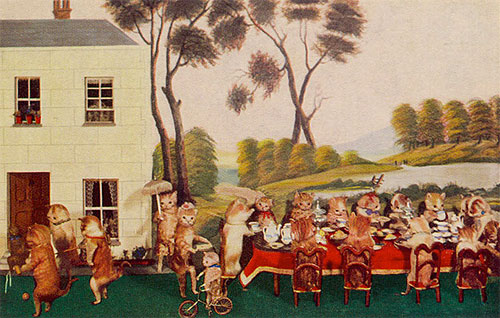
brooklyn diorama club
sloane crosley
pulp fiction
peep show
wilco's dioramas
super mario brothers
paolo ventura
walter potter
Pinched off Web Zen, via BOINGBOING. Web Zen is created and curated by Frank Davis, and re-posted on Boing Boing with his kind permission. Web Zen Home and Archives,
Best
YouTube
Ever
[youtube=http://www.youtube.com/watch?v=muLIPWjks_M&color1=0xb1b1b1&color2=0xcfcfcf&hl=en&fs=1]
One of the best Flickr sets I've seen in ages. It is, as the name suggests, disassembled household appliances. Some of it's not so well executed - lighting is a bit off etc - but it's still impressive.

Breville

Electric carving knife

Juicer
The rest are all here.ost = (("https:" == document.location.protocol) ? "https://ssl." : "http://www.");
document.write(unescape("%3Cscript src='" + gaJsHost + "google-analytics.com/ga.js' type='text/javascript'%3E%3C/script%3E"));
var pageTracker = _gat._getTracker("UA-3425016-1");
pageTracker._initData();
pageTracker._trackPageview();
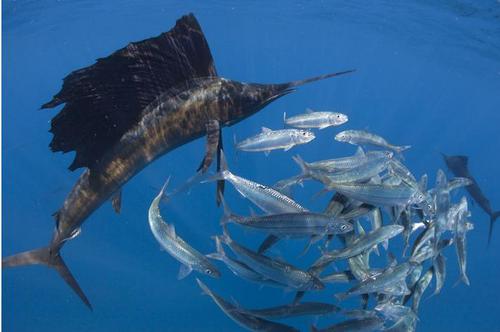
"Paul Nicklen's amazing underwater photos of sailfish are a stunning series of seriously bizarre-looking sailfish attacking a school of sardines as big as an elephant." In the Whirl (Thanks, Marilyn!)
(from BoingBoing)
var gaJsHost = (("https:" == document.location.protocol) ? "https://ssl." : "http://www.");
document.write(unescape("%3Cscript src='" + gaJsHost + "google-analytics.com/ga.js' type='text/javascript'%3E%3C/script%3E"));
var pageTracker = _gat._getTracker("UA-3425016-1");
pageTracker._initData();
pageTracker._trackPageview();
These newlyweds know how to party. They were tasered and arrested at their raucous wedding reception, and two days later they were tasered and arrested again.

(Photo by Kacper Skowron/For the Sun-Times)
"The short version of the story is they didn't want to quit their partying," said Mike Sepic, Berrien County, Mich., chief assistant prosecutor. "If you put this in the class of wedding receptions gone bad, I guess this would take the cake."
And the story didn't end after the reception. Two nights later, the bride and groom were again arrested in Michigan -- and again shocked by a stun gun -- after struggling with police investigating a noise complaint, Sepic said. The groom was charged with pushing his new wife down during that incident, but the charge was later dropped as part of a plea bargain, Sepic said.
Newlyweds are Tasered, arrested at reception melee, and again two days later (suntimes.com) (via For Your Entertainment)
var gaJsHost = (("https:" == document.location.protocol) ? "https://ssl." : "http://www.");
document.write(unescape("%3Cscript src='" + gaJsHost + "google-analytics.com/ga.js' type='text/javascript'%3E%3C/script%3E"));
var pageTracker = _gat._getTracker("UA-3425016-1");
pageTracker._initData();
pageTracker._trackPageview();
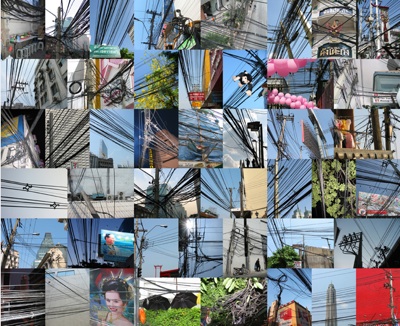
Thomas Kalak is a photographer from Munich, Germany who specializes in the offbeat. His subject is the curious art of found technology. He's accumulated a magnificent gallery of old American cars in Cuba called "Havana Oldtimers". In Thailand he focuses on the often-seen but rarely-noticed jumble of wires that weave their way overhead every street. Adhoc in design, these almost organic nests have their own charm if you let them seduce you. Kalak has collected an entire portfolio of Bangkok Wires.
These and more are included in a new book about Thailand called "Thailand -- Same Same, But Different. No cliches here. No lovely maids, palm beaches or grand temples. Instead Kalak captures odd moments of street use. Plastic chairs in alleys; traffic cone patterns. Even the locals are blind to their off-center beauty. Kalak has a keen eye for the way folks improvise. I think of this work as improv zen.

The ubiquitous plastic bag becomes an instant cheap bottle if you add a straw. And you can hang it anywhere.

Owner-built key ring boards.
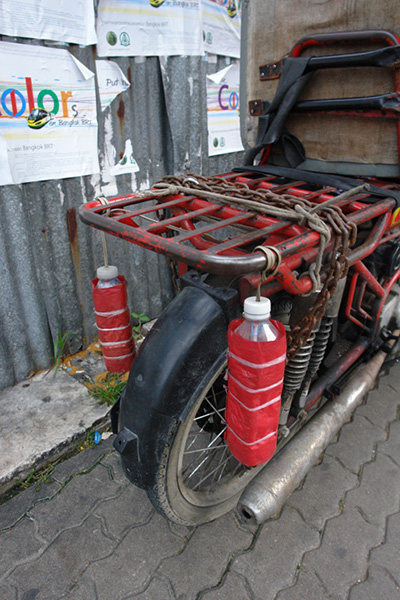
I think these are home-made brake lights. Suspended by a wire, a bulb inside a bottle covered with read plastic will light up at night.
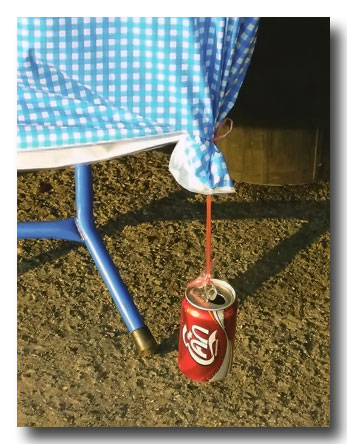
Filled with water this can keeps the table cloth from blowing away.
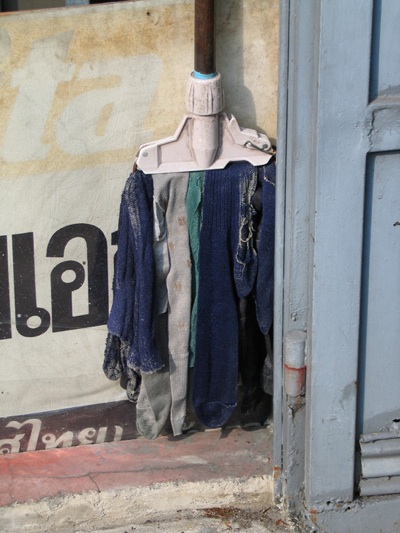
A mop made from old socks!!
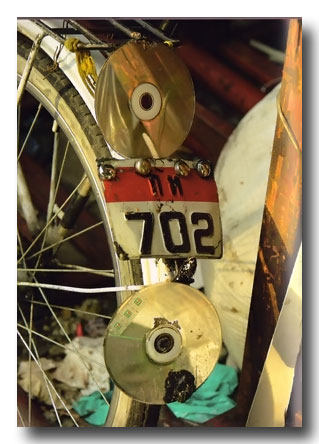
Reflectors made from CDs.
From KK Streetuse.
var gaJsHost = (("https:" == document.location.protocol) ? "https://ssl." : "http://www.");
document.write(unescape("%3Cscript src='" + gaJsHost + "google-analytics.com/ga.js' type='text/javascript'%3E%3C/script%3E"));
var pageTracker = _gat._getTracker("UA-3425016-1");
pageTracker._initData();
pageTracker._trackPageview();
var gaJsHost = (("https:" == document.location.protocol) ? "https://ssl." : "http://www.");
document.write(unescape("%3Cscript src='" + gaJsHost + "google-analytics.com/ga.js' type='text/javascript'%3E%3C/script%3E"));
An investigation has been launched into claims that cheeky police are said to have left a fridge-magnet calling card after smashing into the wrong house. Officers hunting a criminal recalled to prison for breaching his release conditions broke into the home of a couple in Oldham.
The family came home to find a hole in their back door, police in the yard, and fridge magnets rearranged to spell "OLDHAM TASK FORCE CALLED".
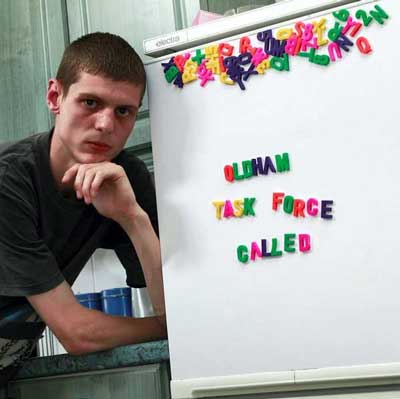
Aaron West, his partner Leeanne Baker, and their two-year-old son Leighton had only moved into the rented house in Letham Street, Hathershaw, 11 days earlier.
Mr West, 20, said: "It's pathetic and childish. I want a written apology. We came back from shopping to find the back door smashed in and on the kitchen work top. The police here didn't tell us much, so I went to the station to ask why. But when I told the desk sergeant I didn't know who they were looking for, they just weren't interested.
"When I came home I noticed the fridge magnets had been rearranged and said: `OLDHAM TASK FORCE CALLED'. "These are for children, they're not for the police to leave a message they've raided your house."
Police bosses have launched an investigation.
From here.
var pageTracker = _gat._getTracker("UA-3425016-1");
pageTracker._initData();
pageTracker._trackPageview();


